```json
{
"text": "
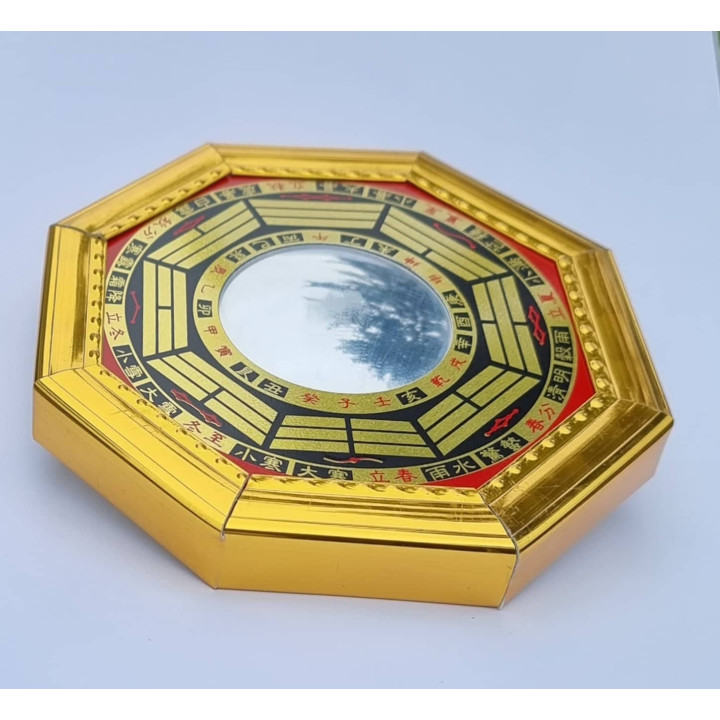
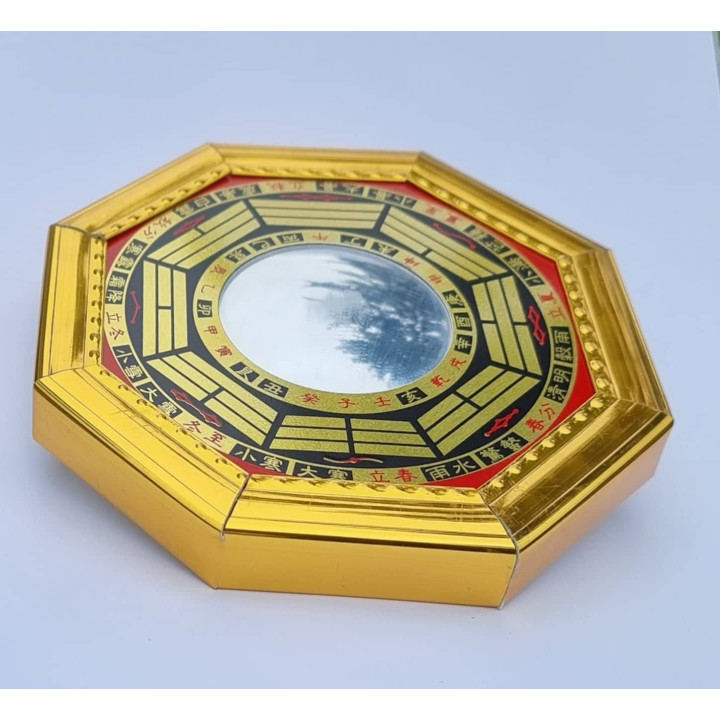
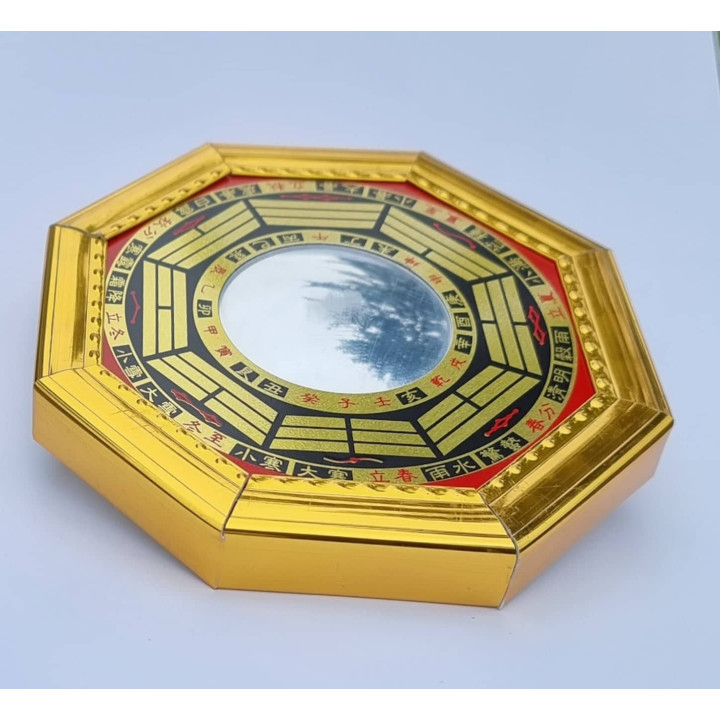
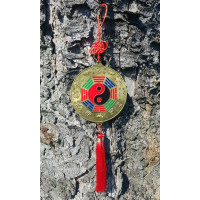
bagua – convex mirror (exterior)
\n
This bagua – convex mirror (exterior) is used to help define the location of energy in both people and environments.
\n
The bagua is also used as a protective symbol inside homes.
\n
This bagua – convex mirror (exterior) measures 16 cm x 16 cm and is entirely made of wood with a circular convex mirror at the center.
\n
The mirror is convex on the exterior of the bagua, protruding from it.
\n
\n
Brief explanation about Bagua and Yin Yang:
\n
The bagua (which means “eight symbols”) is the union of eight trigrams used in Taoist philosophy to represent fundamental principles of reality, seen as a series of eight interconnected concepts.
\n
Each consists of three lines, where a broken line represents Yin energy and an unbroken line represents Yang energy. Due to their tripartite structure, they are often referred to as “trigrams.” The trigrams are related to the philosophy of tai ji (Tai-Chi) and the Wu Xing (five elements). In Chinese philosophy, Yin and Yang describe how seemingly opposing or contrary forces are actually complementary and interconnected in nature. These energies emerge when they interact with each other; thus, the whole is more important than each energy or aspect alone. The bagua serves to define the location of energy in both people and environments.
\n
Each symbol represents the main phases of natural cycles: sky, earth, wind, water, mountain, thunder, fire, and lake. These have been expanded to include celestial cycles consisting of sun, moon, stars, day, night, morning, evening, wind, thunder, rain, and cloud phases; and terrestrial cycles consisting of mountain, river, lake, swamp, fire, water, tree, flower, and grass phases. These are symbolized by various combinations of the eight trigrams in pairs to form 64 hexagrams. These concepts apply to Taoist philosophy, the I Ching, and Chinese martial arts.
\n
The I Ching, or Yi Jing, also known as the Book of Changes, is a collection of principles used to interpret nature through trigrams and hexagrams.
"
}
```





Comments (0)
Your review appreciation cannot be sent
Report comment
Report sent
Your report cannot be sent