```json
{
"product_data": {
"title": "
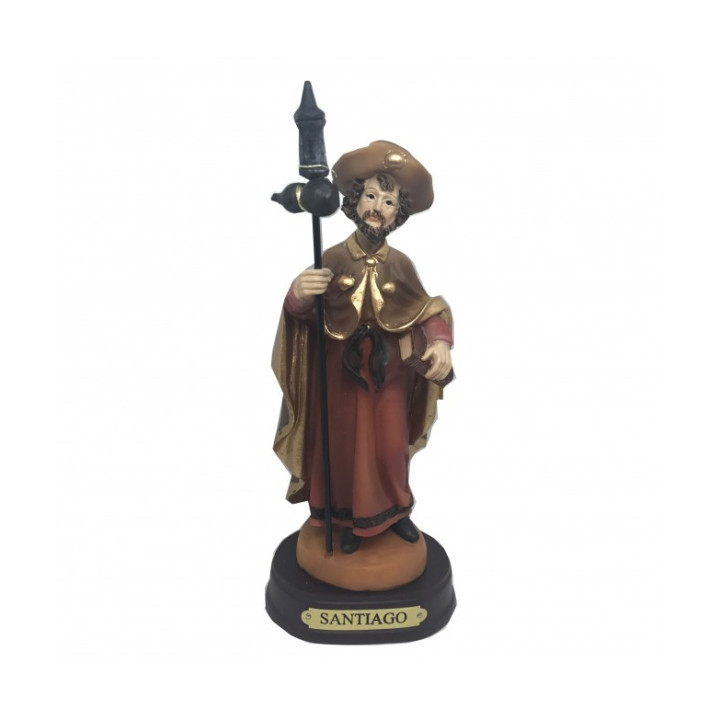
Saint James - 15cm
",
"description": "
July 25 is dedicated by the Catholic Church to Saint James, one of Jesus' disciples, who is especially celebrated in Santiago de Compostela, Galicia, attracting thousands of pilgrims from around the world who travel along the so-called “Camino de Santiago” routes.
Santiago de Compostela is a city located in Galicia, near the border with Portugal. It was named after the remains of Saint James the Greater, one of the main Apostles of Jesus, were found there. This devotion became so significant that a cathedral was built in the city and the “Camino de Santiago” pilgrimage routes were established, which are walked by thousands of pilgrims. All these routes lead to Santiago de Compostela, and this journey is considered an important rite of passage for those who undertake it, being not only a journey of faith but also a significant spiritual and self-discovery journey.
The Apostle James (known as Saint James the Greater) was one of Jesus' closest friends. A fisherman, he was invited by Jesus to be his disciple and “fish” for souls, spreading Christian faith. He was present with Jesus during important moments in the history of Christianity, including some of the greatest miracles, such as the Transfiguration of the Lord. After Jesus’ death, his disciples set out to spread His word around the world, and James went to Spain, becoming responsible for its evangelization and later its patron saint. He was killed on the orders of King Herod when he returned to Jerusalem, being the only Apostle of Jesus to be sacrificed for his faith and whose death is described in the Bible. It is narrated that before dying, he embraced his executioner, praying that Christ’s peace would accompany him. This gesture so moved the executioner that he also converted and was subsequently executed as well. It is said that James’ body was buried in Jerusalem and later transported by two Apostles to Galicia, where James lived.
Devotion to the place that would become Santiago de Compostela began in the 9th century when a hermit living in the forest of Libredón saw a spectacular celestial phenomenon resembling a meteor shower on several consecutive nights. Finding this strange, he reported it, leading to excavations at the site where the remains of someone believed to be Saint James were found. As a result, three churches were built there, and with a large influx of pilgrims, King Alfonso III ordered the construction of a cathedral in 872. Over time, not only Spanish but also French, German, and English pilgrims began to travel to Santiago de Compostela, leading to the creation of specific routes – the “Camino de Santiago.” During the Middle Ages, the Church granted full forgiveness of sins to those who made the pilgrimage to Santiago de Compostela, making it the third most important Catholic site after Jerusalem and Rome.
There are several Camino de Santiago routes across Europe, including the Portuguese route that starts from the Church of Santiago in Lisbon or the Sé Cathedral, and can be done along the coast or through the interior. All Camino de Santiago routes are marked by scallop shells and yellow arrows, leading pilgrims to their destination: the cathedral of Santiago, where pilgrims embrace the statue of the saint.
Saint James is the patron saint of pilgrims, knights, pharmacists, veterinarians, and chemists.
There are many reasons why someone might choose to walk the Camino de Santiago, and beyond faith and devotion to this saint, it often serves as a journey for greater self-discovery and finding one’s path in life. Each person chooses where to start, whether to walk, cycle, or ride a horse, and whether to go alone or with a group. The challenges of the journey, the stops along the way where pilgrims interact with others, sharing stories, and overcoming obstacles are just some of the aspects that make this journey unique.
Trivia:
- One of the names given to our galaxy, the Milky Way, is “Camino de Santiago,” as it is believed that at night, the stars show the way to Santiago de Compostela.
- The Camino de Santiago routes are marked by scallop shells carved into stone markers. There are several explanations for this symbol: one says that initially, the pilgrimage ended in Finisterra, and those who arrived there brought a scallop shell to prove they had been there. Additionally, the scallop represents the spiritual rebirth experienced by those who walk the Camino, with each rib symbolizing different paths converging at the same place. Moreover, the scallop was one of the amulets used in the Middle Ages against plagues, so pilgrims carried a scallop as an amulet.
- There is also a tradition where each pilgrim places a stone in their backpack at the start of the journey for every problem they wish to leave behind. Upon reaching the Cruz de Ferro, they throw the stones over their shoulders, leaving behind problems, vices, and what troubles them. Another tradition involves stacking stones in the area of Torre del Rio, symbolizing the problems left behind. Initially, these piles of stones were used to mark the path.
Material: Resin
"
}
}
```









Comments (0)
Your review appreciation cannot be sent
Report comment
Report sent
Your report cannot be sent